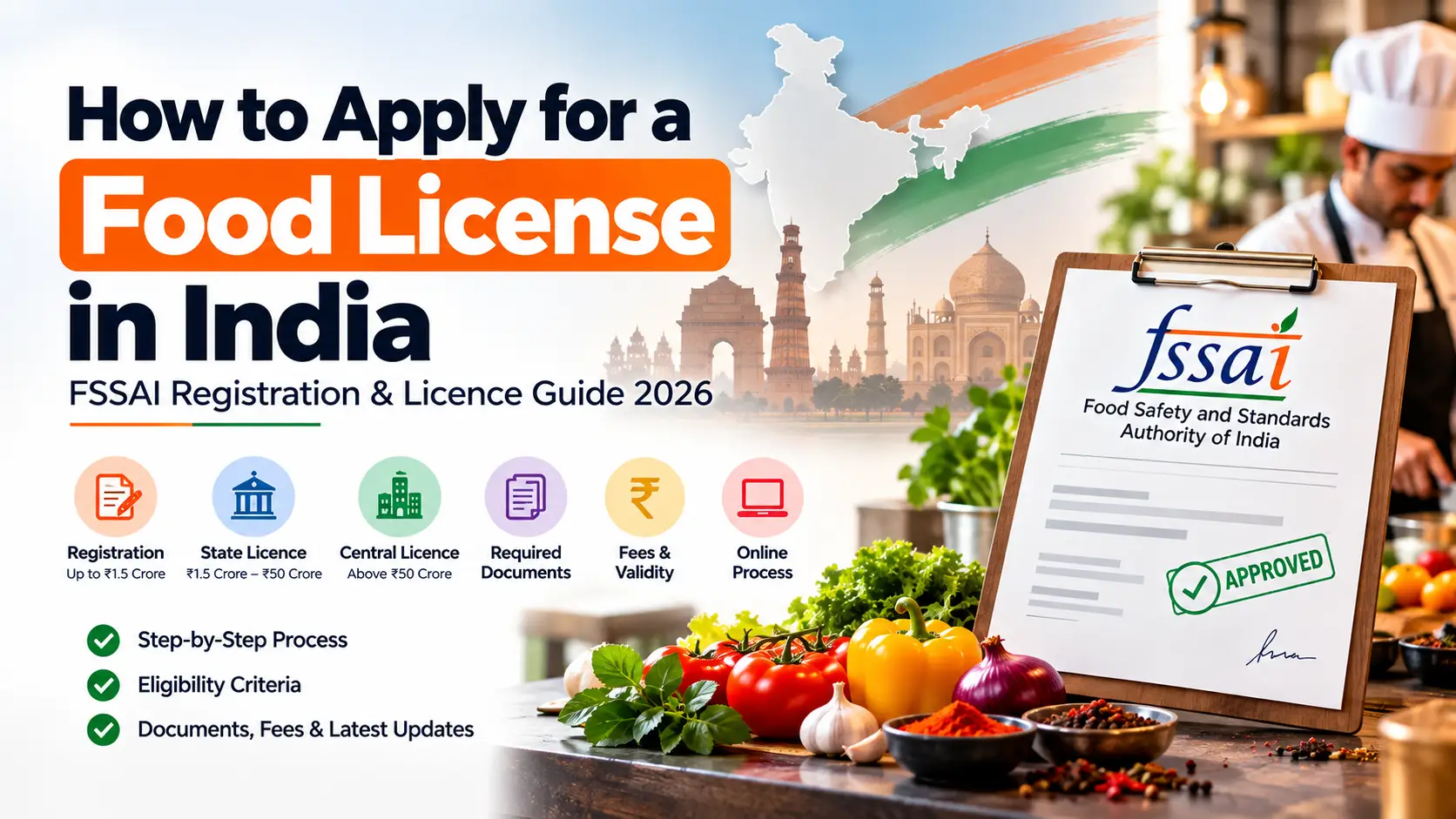
How to Apply for a Food License in India: FSSAI Registration & Licence Guide 2026
If you are starting or operating a food business in India, obtaining the appropriate FSSAI Registration or Food Licence is an important regulatory requirement.
Whether you operate a restaurant, cloud kitchen, food manufacturing unit, bakery, catering business, food shop, food delivery business, wholesaler, distributor or another type of food business, the applicable FSSAI registration or licence depends on the nature and scale of your business.
In this guide, we explain how to apply for a food license in India, the different types of FSSAI registration and licence, eligibility, required documents, application process, government fees, and important changes applicable from 2026.
What Is a Food License?
A food license generally refers to the FSSAI licence or registration issued under India's food-safety regulatory framework.
The Food Safety and Standards Authority of India (FSSAI) regulates food businesses and provides the online FoSCoS system for food business operators to apply for registration and licences.
The exact category depends on the food business, its activities and other applicable eligibility criteria.
Who Needs FSSAI Registration or Licence in India?
Food businesses operating in India may need FSSAI registration or a licence depending on their business activity and applicable eligibility conditions.
Examples include:
- Restaurants
- Cafes
- Bakeries
- Cloud kitchens
- Food manufacturers
- Food processors
- Caterers
- Sweet shops
- Grocery and food retailers
- Food wholesalers
- Food distributors
- Food storage businesses
- Food delivery businesses
- Food importers
- Food vending businesses
- Online food businesses
The appropriate FSSAI category should be determined based on the actual Kind of Business (KoB) and applicable eligibility criteria rather than turnover alone.
Types of FSSAI Registration and Licence
FSSAI broadly provides three levels of registration/licensing:
1. FSSAI Registration
FSSAI Registration generally applies to eligible smaller food businesses.
Under the revised 2026 turnover thresholds, registration applies to eligible food businesses with turnover up to ₹1.5 crore.
However, the exact requirement should be checked against the applicable FSSAI eligibility criteria for the specific business.
2. FSSAI State Licence
The revised threshold provides for a State Licence for eligible food businesses with annual turnover above ₹1.5 crore and up to ₹50 crore.
The appropriate licence category can also depend on the type of food business and other applicable eligibility criteria.
3. FSSAI Central Licence
Eligible food businesses with annual turnover above ₹50 crore fall under the Central Licence threshold under the revised 2026 framework.
Certain food businesses may also fall under Central Licence requirements because of the nature of their activities.
FSSAI Registration vs Licence
It is useful to understand the difference between FSSAI registration and licensing.
| Category | Revised turnover threshold from 1 April 2026 |
|---|---|
| FSSAI Registration | Up to ₹1.5 crore |
| FSSAI State Licence | Above ₹1.5 crore to ₹50 crore |
| FSSAI Central Licence | Above ₹50 crore |
These revised thresholds became effective from 1 April 2026.
The exact category should still be checked against the food business's Kind of Business and applicable eligibility criteria.
How to Apply for a Food License in India
The application is generally submitted online through the official FoSCoS portal.
The broad process is as follows.
Step 1: Identify Your Food Business Category
First, determine the nature of your food business.
For example:
- Restaurant
- Food manufacturer
- Retailer
- Wholesaler
- Caterer
- Bakery
- Food service
- Storage business
- Distributor
- Importer
- Food vending business
The FoSCoS system provides eligibility information based on the type of business.
Step 2: Select the Appropriate Registration or Licence
Based on the business activity and applicable eligibility criteria, select:
- FSSAI Registration
- FSSAI State Licence
- FSSAI Central Licence
Step 3: Enter Business Details
The application requires information relating to the food business and its premises.
This can include:
- Business name
- Applicant details
- Premises address
- State
- District
- PIN code
- Business activity
- Food products
- Turnover and other applicable information
Step 4: Upload Documents
The required documents depend on the type and nature of the food business.
Documents may include identity proof, address proof, premises documents, business constitution documents and other category-specific documents.
Step 5: Pay the Applicable Government Fee
The applicable FSSAI government fee depends on the type of registration/licence and business category.
The official FoSCoS portal provides the applicable fee structure.
Step 6: Application Verification
The application may be reviewed by the appropriate authority.
Depending on the application, the authority may request additional information, clarification, documents or inspection.
Step 7: Receive the FSSAI Registration or Licence
Once the application is successfully processed, the applicable FSSAI registration or licence is issued.
Documents Required for FSSAI Registration
The documents required depend on the food business category.
Common documents may include:
- Applicant's identity proof
- Applicant's address proof
- Photograph
- Proof of business premises
- Rent agreement or ownership document
- Electricity bill or other applicable premises proof
- Business constitution documents
- Partnership deed, where applicable
- Certificate of Incorporation, where applicable
- Details of directors or partners
- Food product details
- Details of food business activities
- Other category-specific documents
For certain Central Licence applications, additional documents may be required depending on the business activity.
FSSAI Food License for Restaurants
Restaurants are a common category of food business requiring FSSAI compliance.
A restaurant may need:
- FSSAI Registration
- FSSAI State Licence
- FSSAI Central Licence
The appropriate category depends on the applicable eligibility criteria, turnover and business activity.
FSSAI for Cloud Kitchens
Cloud kitchens and food delivery businesses should also consider their FSSAI requirements.
Even if the business does not operate a traditional dine-in restaurant, preparing and selling food is still a food-business activity.
The appropriate FSSAI category should be determined based on the actual business operation and applicable FoSCoS classification.
FSSAI for Bakeries and Sweet Shops
Bakeries, sweet shops and similar food businesses may require FSSAI registration or licensing depending on their business activity and applicable eligibility criteria.
The application should accurately describe the food activities and products handled by the business.
FSSAI for Food Manufacturers
Food manufacturers and processors may have additional documentation requirements.
Depending on the manufacturing activity, applicants may need information relating to:
- Manufacturing premises
- Production capacity
- Machinery
- Food categories
- Processing activities
- Layout
- Product details
- Responsible technical personnel, where applicable
The documentation requirements vary according to the nature of the food business.
FSSAI for Small Food Businesses
Small food businesses can include:
- Tea shops
- Snack shops
- Small retailers
- Juice shops
- Small food stalls
- Hawkers
- Temporary food stalls
- Small food vendors
The applicable registration category depends on the current FSSAI eligibility criteria.
How Much Does a Food License Cost in India?
The total cost can include:
- Government FSSAI fee
- Professional or consultancy charges, if assistance is used
- Any applicable additional costs depending on the business and application
The government fee is determined by the applicable registration/licence category and business activity.
Businesses should distinguish between the government fee and any professional service fee charged by a private consultant.
How Long Does FSSAI Registration Take?
Processing time can vary depending on:
- Type of application
- Business category
- Completeness of documents
- Verification
- Clarifications requested by the authority
- Whether inspection is required
- Other case-specific factors
Applicants should therefore avoid relying on a fixed processing time unless it is specifically applicable to their case.
Can I Apply for FSSAI Registration Online?
Yes.
FSSAI provides the FoSCoS online system for new registration/licence applications, renewals and modifications.
Applicants can use the system to:
- Apply for a new registration/licence
- Track an application
- Renew
- Modify an existing registration/licence
- Access relevant information and documents
Important FSSAI Changes in 2026
FSSAI introduced important regulatory changes in 2026.
One significant change is the revised turnover threshold:
- Registration: up to ₹1.5 crore
- State Licence: above ₹1.5 crore up to ₹50 crore
- Central Licence: above ₹50 crore
The revised thresholds took effect from 1 April 2026.
FSSAI's 2026 reforms also introduced changes relating to the validity of registrations and licences. Businesses should check the latest official FSSAI and FoSCoS information before applying.
Common Mistakes When Applying for a Food License
1. Selecting the Wrong Business Category
The Kind of Business should accurately describe the actual food activity.
2. Incorrect Business Address
The premises address should match the supporting documentation.
3. Incomplete Documents
Missing documents can result in clarification requests or delays.
4. Incorrect Food Product Information
Food categories and products should be accurately declared.
5. Using Outdated Information
FSSAI rules and eligibility criteria can change.
For example, the turnover thresholds were revised in 2026.
6. Confusing Government and Consultancy Fees
The government fee and a private consultant's service fee are separate charges.
Why Take Professional Assistance for FSSAI Registration?
Applying for a food licence can involve selecting the correct business category, preparing documents and responding to queries.
Professional assistance may help with:
- Eligibility assessment
- Document preparation
- Application preparation
- FoSCoS filing assistance
- Application tracking
- Clarification responses
- Modification assistance
- Renewal and compliance support
Legal Bharat Services provides private consultancy and filing assistance for businesses seeking FSSAI-related services.
Apply for a Food License with Legal Bharat Services
If you are starting a restaurant, cloud kitchen, bakery, food manufacturing business, catering business, food shop or another food-related business, obtaining the appropriate FSSAI registration or licence can be an important part of setting up your business.
Legal Bharat Services can assist with:
- FSSAI Registration
- FSSAI State Licence
- FSSAI Central Licence
- FSSAI Renewal
- FSSAI Return Filing
- Documentation and application assistance
Need help applying for a food license in India? Contact Legal Bharat Services for professional FSSAI application assistance.
Frequently Asked Questions
Is FSSAI registration mandatory in India?
Food businesses may require FSSAI registration or a licence depending on their type of business and applicable eligibility requirements.
What is the turnover limit for FSSAI registration in 2026?
From 1 April 2026, the revised FSSAI threshold for Registration is turnover up to ₹1.5 crore, subject to applicable eligibility criteria.
What is the turnover limit for an FSSAI State Licence?
Under the revised 2026 thresholds, the State Licence category covers eligible businesses with turnover above ₹1.5 crore and up to ₹50 crore.
What is the turnover limit for an FSSAI Central Licence?
Under the revised 2026 threshold, eligible businesses with turnover above ₹50 crore fall under the Central Licence category.
Can I apply for an FSSAI licence online?
Yes. Applications can be submitted through the official FoSCoS system.
How much does FSSAI registration cost?
The government fee depends on the applicable category. Professional service charges, if any, are separate.
Does a cloud kitchen need FSSAI registration?
A cloud kitchen is a food business and may require the appropriate FSSAI registration or licence depending on its activities and eligibility.
Can Legal Bharat Services help with FSSAI registration?
Yes. Legal Bharat Services provides consultancy, documentation and filing assistance for FSSAI-related applications.
Conclusion
Applying for a food license in India is an important compliance step for many food businesses.
The correct FSSAI category depends on the nature of the food business and the applicable eligibility criteria. From 1 April 2026, FSSAI revised the turnover thresholds for Registration, State Licence and Central Licence, making it especially important to use current information when preparing an application.
Before applying, businesses should prepare accurate information about their premises, business activity, food products and supporting documents.
If you need assistance with FSSAI Registration or Food Licence in India, Legal Bharat Services can help with application preparation and filing support.